There’s a particular kind of discomfort that’s hard to name. The room is tidy. The furniture is tasteful. Nothing is technically wrong — and yet, when you settle into the space, something feels slightly off. A low hum of unease that no amount of rearranging quite resolves.
It isn’t clutter, exactly. It isn’t darkness or noise. It’s more like a frequency the room is emitting that doesn’t match the one you’re hoping to rest inside.
If you’ve felt this, you’re not imagining it. Learning how to make your home feel calm is less about aesthetics and more about the relationship between a space and the nervous system living inside it.
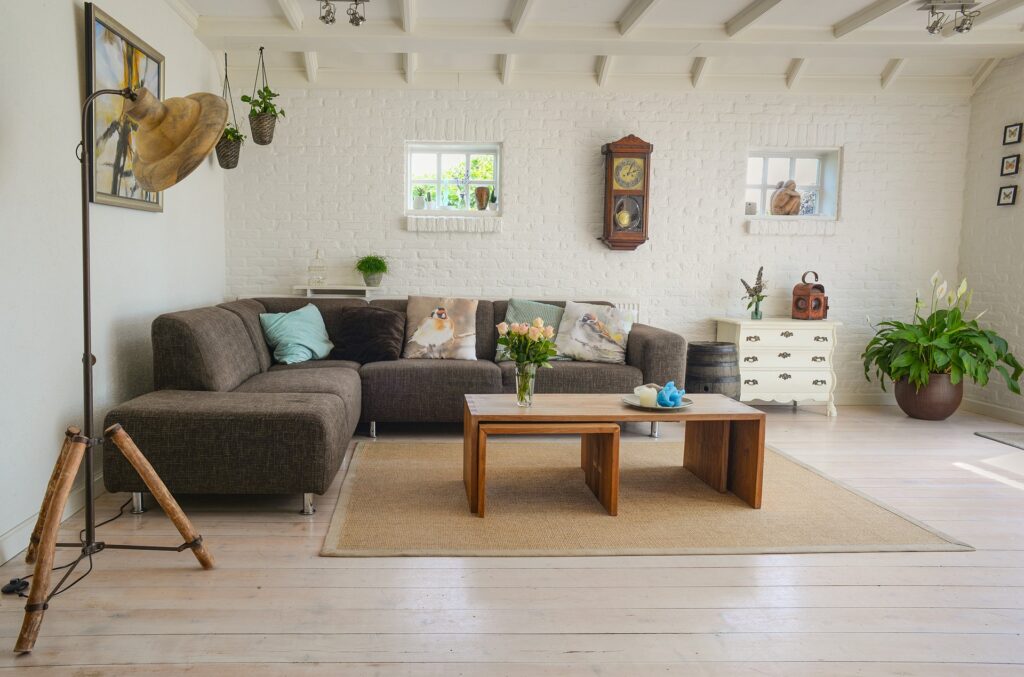
Why a Decorated Home Can Still Feel Restless
We tend to treat home design as a visual problem. We source the right pieces, choose the right palette, and follow the right references. But calm isn’t purely visual. It’s sensory, emotional, almost atmospheric.
A room can be beautifully appointed and still feel like it’s asking something of you — demanding attention, signaling status, performing a version of life rather than quietly holding one.
This happens when the choices in a space are made for appearance rather than atmosphere. When every surface carries an object. When the light is functional but not considered. When the room has been designed to impress rather than to settle.
The truth is that calm is less about what you add and more about what you allow to remain absent.
Reducing Visual Noise
The human eye moves constantly. In a room with many competing focal points — a cluster of frames, a busy gallery wall, surfaces filled with small decorative objects — the eye never fully rests. And when the eye doesn’t rest, neither does the mind.
Calm home decor ideas often begin here: with the deliberate quieting of visual noise.
This doesn’t mean minimalism in the austere, cold sense. It means editing with intention. It means asking, for each object: does this earn its place not just as something I own, but as something that genuinely contributes to how this room feels?
A shelf with three objects breathes differently than a shelf with fifteen. A wall with one considered piece speaks differently than a wall covered in everything you’ve ever loved. The difference is the space around things — the silence that allows each element to be felt rather than just seen.
A Note on Restraint
Restraint is not deprivation. It’s discernment. When you remove what is merely filling space, what remains becomes more present, more meaningful. A room that breathes has room for you in it.
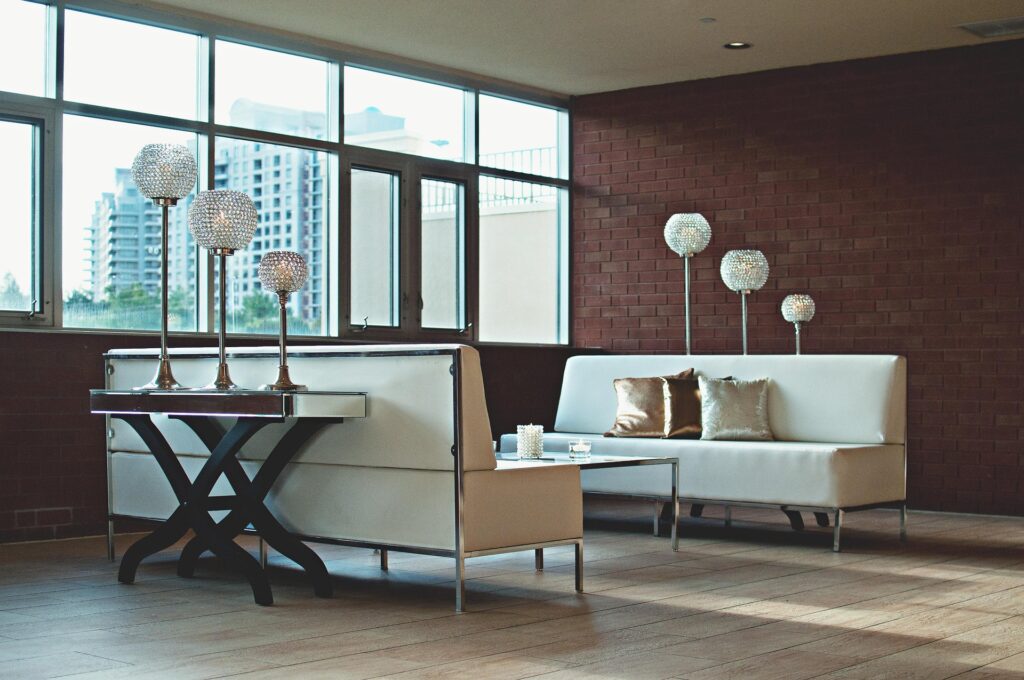
Choosing Fewer, More Meaningful Objects
One of the quietest shifts you can make in a home is to be ruthlessly selective — not in a cold, curatorial way, but in the way of someone who has learned to trust their own taste.
Objects carry emotional weight. Some carry history, some carry beauty, some carry both. Others carry obligation — they were gifts, or purchases made hastily, or pieces that seemed right once but no longer do.
When you pare a space down to only what genuinely moves you, something changes. The room begins to hold your actual preferences rather than a record of your accumulated decisions.
This is at the heart of how to create a peaceful home: not achieving some magazine-perfect ideal, but creating a space that reflects the quietest, most authentic version of your sensibility.
The Softness of Light, Texture, and Open Space
Calm is felt through the body before it’s registered by the mind. This means that the softer, more sensory elements of a room — light, texture, negative space — carry an enormous amount of emotional weight.
Light: Harsh overhead lighting puts a room on stage. Warm, layered light — a lamp in a corner, light that pools rather than floods — allows a room to settle. Natural light, allowed to move freely across walls and floors, changes a room through the day in a way that is subtly enlivening.
Texture: Smooth, hard surfaces read as alert and precise. Soft textures — linen, matte ceramics, weathered wood, woven fibers — invite a different kind of engagement. They suggest rest. They suggest that the room is for living in, not just looking at.
Open space: Perhaps the most undervalued element in any room is what isn’t there. Empty space is not wasted space. It is the room breathing. It is the visual equivalent of silence — necessary, generative, and easy to mistake for lack.
Letting Art Define the Emotional Tone
A room without art can be functional and even beautiful, but it often lacks a felt quality — that indefinable sense that the space has a point of view, a mood, an inner life.
Art sets emotional tone in a way that furniture simply cannot. A single piece on a quiet wall does something that a gallery of pieces cannot: it becomes a focal point for the whole room’s feeling, something the eye and the attention return to naturally.
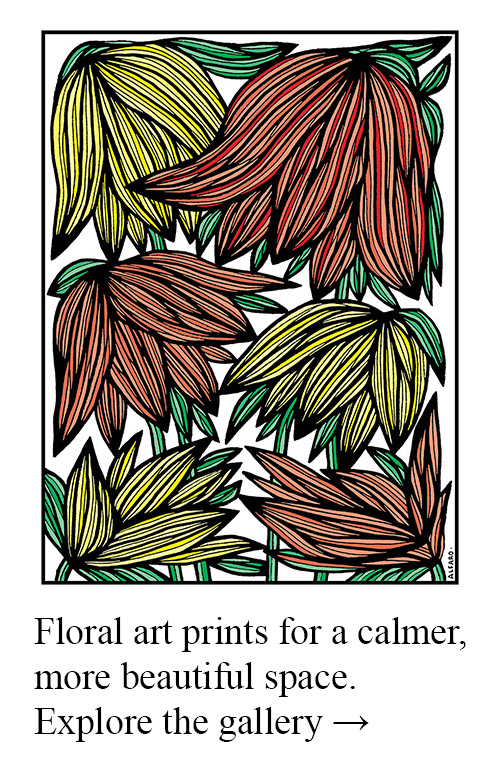
For spaces aspiring toward calm, the most effective choices tend to be art that doesn’t demand too much — work with openness in its composition, room for the eye to wander without getting caught. Botanical prints, fine line drawings, works that hold softness and restraint in their imagery, carry their quiet into the room with them.
Floral artwork, in particular, has a long history in interior spaces for a reason that goes beyond decoration. A carefully composed floral print — especially one rendered with restraint, in a limited palette or fine linework — brings something organic and grounded into a space. It connects the room to something larger and slower than the pace of daily life.
This is not about following a trend. It’s about understanding that the images you choose to live with are, in a real sense, teaching your nervous system what the room is for.
One Piece, Chosen Well
There is no formula here, but there is a principle: a single piece of art chosen with genuine attention to how it feels — not just how it looks — will do more for the atmosphere of a room than any collection assembled quickly or at random.
The question to ask isn’t “does this match?” It’s “does this feel like the room I’m trying to inhabit?”
Creating Breathing Room
Breathing room is not a design concept — it’s a physiological one. It refers to the space in a room that allows you to exhale.
This can be achieved through many means: a corner left intentionally spare, a windowsill with nothing on it, a table surface kept clear, a hallway with nothing on the walls. These are not oversights. They are decisions. They are the spaces that allow everything else to be seen.
In minimal feminine home decor — and in any decor oriented toward calm — breathing room is often the defining feature that separates a space that merely looks right from one that genuinely feels right. It is the margin of the page. It is what lets the room be read.
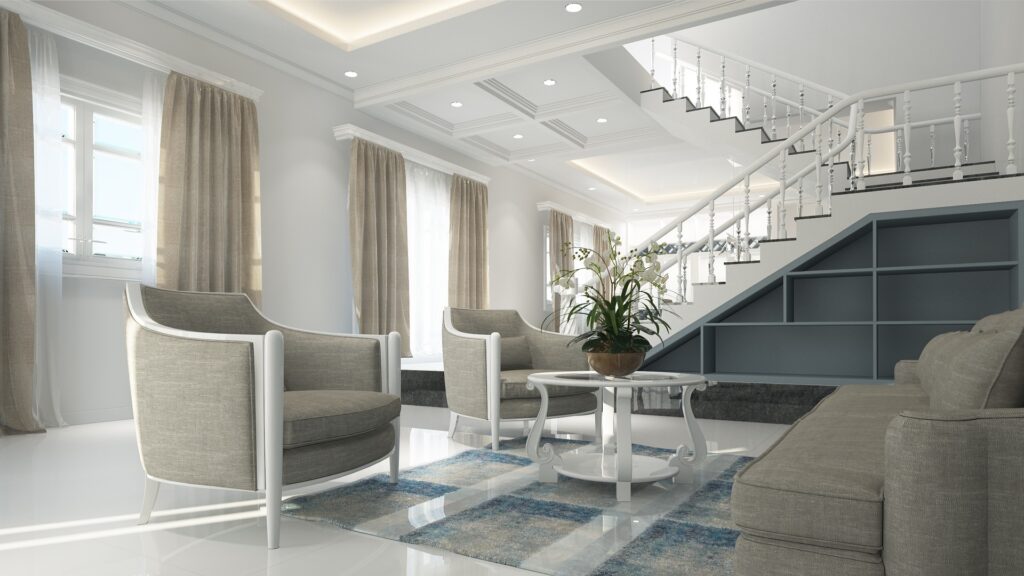
A Few Quiet Shifts That Change Everything
- Replace one busy surface with a single object you truly love
- Swap an overhead light for a lamp placed in a darker corner
- Remove one piece of wall art and notice what opens up
- Choose a linen or cotton throw in a tone that feels quiet to you
- Find one piece of art that makes you feel still when you look at it
- Let a shelf or a windowsill sit empty for a week before deciding what belongs there
- Pay attention to how a room feels at different times of day — and adjust what you can
- Buy less, but buy it slowly and with more certainty
What a Calm Home Really Is
A calm home is not a solved home. It is not a finished home or a perfect one. It is a home that has been considered — where the choices have been made with some attentiveness to feeling, not just appearance.
It is a home that makes room for stillness.
When you walk in and the quality of the light, the quiet of the surfaces, the image on the wall — when these things align with what you were hoping to feel, something releases. Not dramatically. Quietly. Like a breath you didn’t know you were holding.
That’s what all of this is for. Not a beautiful room. A room that makes you feel like yourself.
The Quiet Bloom offers a curated collection of art prints designed for spaces that value stillness — botanical line drawings, soft floral compositions, and works made to be lived with slowly.